
India strongly criticised Pakistan at the United Nations, labelling it a "Frankenstein state" for its alleged support of terrorism. The remarks came after Pakistan and the OIC raised the Kashmir issue, which India firmly rejected, reiterating Jammu and Kashmir's integral status. India also deemed the Indus Water Treaty "outdated" given Pakistan's policies.

India has strongly condemned Pakistan's military airstrikes against Afghanistan, citing significant civilian casualties, and criticised its 'trade and transit terrorism' against Afghan traders, calling these actions blatant violations of international law and UN norms.

India has strongly criticised Pakistan at a UN Security Council meeting, asserting its right to defend itself against cross-border terrorism and warning of consequences for Pakistan's support of such activities.
India has strongly criticised Pakistan at a UN Security Council meeting, asserting its right to defend itself against cross-border terrorism and warning of consequences for Pakistan's support of such activities.

The Vishva Hindu Parishad (VHP) has appealed to the United Nations to intervene on behalf of religious minorities in Pakistan and Bangladesh, citing human rights violations.
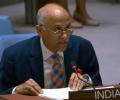
India has strongly criticised Pakistan at the UN Security Council, highlighting civilian deaths and injuries in Afghanistan caused by cross-border violence by Pakistani military forces, accusing Pakistan of 'heinous acts' and 'systematic genocide'.

Pakistan has criticised India's recent remarks on Pakistan-occupied Kashmir (PoK) protests, asserting it is addressing issues democratically. Pakistan also warned India against blocking water, calling it an "act of war," and commented on India's nuclear capabilities and its own military strikes in Afghanistan.

Sonia Gandhi criticised PM Modi's Israel visit, calling it a "bewildering strategic decision" amid the regional conflict.

India has strongly condemned Pakistan's airstrikes on Afghanistan, calling them a flagrant violation of international law and hypocritical given the civilian casualties during Ramzan.
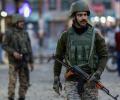
UN Secretary-General Antonio Guterres has called for maximum restraint between India and Pakistan following a deadly terror attack in Jammu and Kashmir. Guterres' spokesperson, Stephane Dujarric, said that the UN chief is following the situation "very closely and with very great concern." Dujarric also stated that any issues between the two countries "can and should be resolved peacefully, through meaningful, mutual engagement." India has downgraded diplomatic ties with Pakistan and announced a raft of measures, including expulsion of Pakistani military attaches, suspension of the Indus Water Treaty of 1960 and immediate shutting down of the Attari land-transit post in view of the cross-border links to the terror attack.

India strongly criticized Pakistan at the United Nations for misusing UN platforms to promote a divisive agenda by repeatedly raising the issue of Jammu and Kashmir.
Asserting that democracy is an 'alien' concept for Pakistan, India has called upon Islamabad to end grave human rights violations in territories under its illegal occupation, where the population is in 'open revolt' against military occupation, repression, brutality and exploitation.

The question nobody seems to ask is why a democracy should be silent when many of its citizens are concerned about the way the US is deviating from its traditional ways of consultation, cooperation and collaboration and moving away from traditional allies, asks Ambassador T P Sreenivasan.

The US-China rapprochement, however tenuous, is not without implications for India. Both China and Pakistan have become closer to the US, notes Ambassador T P Sreenivasan.

India's Permanent Representative to the UN, Ambassador Parvathaneni Harish, delivered a sharp response to comments made by Pakistan's Ambassador to the UN, Asim Iftikhar Ahmad.

Every UN secretary-general has flagged the financial situation, but Antonio Guterres has issued the direst warning yet, calling it a 'race to bankruptcy and of imminent financial collapse, points out Ambassador T P Sreenivasan.

As he settled down to his job as army chief, General Qamar Javed Bajwa -- who died last week; his passing did not merit even an obituary in major print or electronic media in Pakistan! -- developed a vision of reducing his country's and his institution, the army's traditional hostility toward India, points out Rana Banerji, who headed the Pakistan desk at RA&W.

The United States' historical strategic alignment with Pakistan, dating back to the Cold War, has consistently aimed to create a political and military parity with India, despite India's significantly larger size and resources. This long-standing relationship continues to influence regional dynamics, particularly in West Asia and the Indo-Pacific.

The UN Security Council, with India's support, has adopted a resolution condemning Iran's attacks on Gulf Cooperation Council countries and Jordan, demanding an immediate cessation of hostilities and denouncing threats to the Strait of Hormuz.

India strongly responded to Pakistan's remarks on Jammu and Kashmir and the Indus Waters Treaty at the UN Security Council, accusing Pakistan of supporting terrorism and violating the spirit of the Indus Waters Treaty.

India's National Security Advisor Ajit Doval is expected to attend a major security meeting in Moscow next week, organized by Russia's Security Council. Doval is invited for the 13th international meeting of high representatives for security issues, taking place from May 27-29. The meeting, chaired by Sergei Shoigu, Secretary of the Security Council of the Russian Federation, will see participation from over 150 countries and international organizations. Pakistan's NSA, Lt Gen Asim Malik, is also expected to attend the meeting, leading to speculation of a possible face-to-face meeting between the two NSAs amidst heightened tensions between India and Pakistan following the Pahalgam attack and subsequent retaliatory actions.

The Ministry of External Affairs (MEA) has stated that India is closely monitoring developments in West Asia, addressing topics ranging from ceasefire efforts to maritime security and the safe return of Indian nationals. The MEA also addressed the UN Climate Change Conference and the delimitation bill.
China and Pakistan are in a tight strategic alliance. India must deal with them one at a time, but be prepared in case they decide to collude, points out Shekhar Gupta.
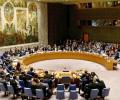
Pakistan and China have submitted a joint bid at the UN Security Council to designate the Balochistan Liberation Army (BLA) and its suicide wing - Majeed Brigade - as a terrorist entity under the Council's 1267 Al Qaeda Sanctions Committee.
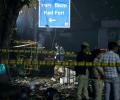
A UN Security Council report indicates that Pakistan-based Jaish-e-Mohammed (JeM) was reportedly linked to a terror attack on the Red Fort in New Delhi. The report also highlights JeM's activities, including the establishment of a women-only wing and its presence in the region.

'I am pleased to announce the Governments of India and Pakistan have agreed to an immediate ceasefire and to start talks on a broad set of issues at a neutral site.'
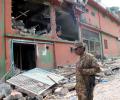
'If destroyed runways and burnt-out hangers look like victory, as the prime minister claimed, Pakistan is welcome to enjoy it.'

A Pakistani terrorist, tasked with executing attacks for Lashkar-e-Taiba in Jammu and Kashmir, surprisingly paused his mission to fulfil a personal desire: undergoing a hair transplant in Srinagar.

The UN Security Council will vote on a Bahrain-proposed resolution regarding the Strait of Hormuz, aiming to ensure freedom of navigation amid concerns and opposition from some members.
Lashkar-e-Taiba (LeT) terrorist Abdullah, alias Abu Hureira, who was tasked with establishing bases outside Jammu and Kashmir, adopted various professions, including share trading, to blend in with the local population. He was recently arrested along with other members of his network.
In a strong retort against Pakistan in the United Nations Security Council, India on Monday said its neighbour as a country that 'bombs its own people' and conducts 'systematic genocide'.
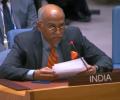
India's Permanent Representative to the UN, Ambassador Parvathaneni Harish, has sharply criticized Pakistan, calling it the "global epicenter of terrorism" and accusing it of providing state support to cross-border terrorism. Harish's remarks came in response to Pakistan's Deputy Prime Minister and Minister of Foreign Affairs Mohammed Ishaq Dar's comments on Jammu and Kashmir during a UN Security Council meeting. India highlighted that Pakistan harbors over 20 UN-listed terrorist entities and has a history of supporting groups like Jaish-e-Mohammed and Harkat Ul Mujahidin. India also emphasized that Jammu and Kashmir is an integral part of India and that Pakistan's misinformation campaign does not change the reality on the ground.

The Dhurandhar movies will undoubtedly shape the minds of the audience much more than news reports, court investigations, books and documentaries. But it is worth remembering that Pakistan's irridentist claims against India's national security have succeeded due to strategic planning, diplomacy, and the unsung heroines and heroes across government agencies, not due to a single maverick leader, points out Shweta Desai.But it is worth to remember that Pakistan's irredentist claims against India's national security have succeeded due to strategic planning, diplomacy, and the unsung heroines and heroes across government agencies -- not a single maverick, points out Shweta Desai.
India attended the inaugural meeting of US President Donald Trump's Board of Peace on Gaza as an observer country, represented by Charge d'affaires at the Indian Embassy in Washington DC, Namgya Khampa.

With Sunday's big clash against arch-rivals India coming up, fans and critics alike are left wondering- can Babar deliver when it really matters?

China has reaffirmed its territorial claims over the Shaksgam Valley, dismissing India's objections to infrastructure projects in the area. The Chinese Foreign Ministry spokesperson stated that the territory is part of China and its activities there are beyond reproach.
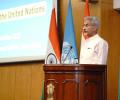
External Affairs Minister S Jaishankar criticizes Pakistan's attempts to protect a terror group at the UN Security Council, highlighting the need for urgent reforms within the global body.
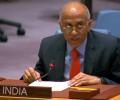
India's Permanent Representative to the UN Ambassador Parvathaneni Harish said that the Indian sub-continent offers a "stark contrast" in terms of progress, prosperity and development models.

India has strongly criticized Pakistan for its human rights violations against protesters in Pakistan-Occupied Kashmir (PoK), citing systemic oppression and plundering of resources.

Lashkar-e-Taiba terrorist Umer Harris, also known as 'Khargosh', is believed to be in Saudi Arabia after escaping India using a forged passport. An investigation into the inter-state LeT terror module has exposed systemic loopholes and raised concerns about passport issuance processes.
